What to wear to a winter football match in Japan
Japan's J.League now plays through December and February. How cold it gets, how to dress for a night game, what to buy on arrival and where to warm up.
Since the 2026/27 season, the J.League runs from August to May, with a winter break in between. That means league games in mid-December and again from mid-February, often under floodlights. If you are visiting from somewhere warm, a Japanese winter night in an open stadium can be a surprise.
How cold does it get?
Night games finish around 9 pm, when the temperature is close to the daily low. These are the long-term averages for the main cities.
| City | December: average high / low | February: average high / low |
|---|---|---|
| Tokyo | 12.0°C / 3.8°C | 10.9°C / 2.1°C |
| Kyoto | 11.6°C / 3.5°C | 10.0°C / 1.6°C |
| Osaka | 12.3°C / 5.3°C | 10.5°C / 3.2°C |
| Fukuoka | 12.6°C / 5.8°C | 11.6°C / 4.4°C |
Source: Japan Meteorological Agency, 1991–2020 averages.
Those numbers do not tell the whole story. Stadiums are big, open structures, you sit still for two hours, and the wind often blows straight through the stands. Grounds near the coast, such as Kashima, and in inland basins, such as Kameoka near Kyoto, can feel colder still. Plan for it to feel a few degrees colder than the forecast.
What to wear: layer from the feet up
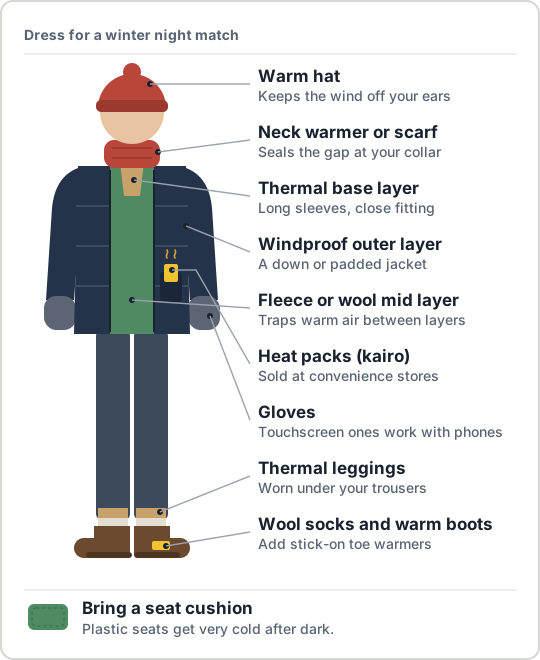
Cold usually starts at your feet, because the concrete stands draw the heat out of them. Start with wool socks and warm, closed shoes or boots, and add thermal leggings under your trousers.
On top, three layers work best: a close-fitting thermal base layer, a fleece or wool mid layer that traps warm air, and a windproof outer jacket, ideally padded or down. Finish with a hat that covers your ears, a neck warmer or scarf to close the gap at your collar, and gloves. Gloves that work with touchscreens let you check your phone and show your QR ticket without taking them off.
A seat cushion makes a bigger difference than you might expect: plastic seats get very cold after dark.
Buy these after you land
You do not need to pack everything from home. Japan is very good at winter warmth, and the essentials are easy to find.
Disposable heat packs (kairo) are sold at convenience stores and drugstores everywhere. There are shake-to-heat packs for your pockets, stick-on packs for your back or the inside of a jacket, and thin ones made for the toes of your shoes. Follow the instructions on the pack, and don’t stick them directly onto your skin or sleep with them, as they can cause low-temperature burns.
Thermal underwear is sold cheaply at Japanese clothing chains in winter, and is thin enough to wear under ordinary clothes.
Hot drinks are sold in vending machines all over Japan. In winter, look for the red labels, which mark drinks that are served hot. A hot can in your gloved hands is a pleasant way to warm up before kick-off.
Where to warm up before and after the game
Arrive with time to spare, but don’t wait outside in the cold longer than you need to. Station cafés and shopping centres near many stadiums are good places to stay warm until the gates open, and stadium concourses are sheltered from the wind.
After the final whistle, crowds for the trains and buses can mean a long wait outdoors. Many fans wait out the rush somewhere warm, such as a nearby restaurant or café, and head home 30 minutes later. Each club guide has tips for getting back from that stadium.
Stay close to the stadium on match night
Night games finish late and stations get crowded. Staying near the stadium means a short walk back instead of a long journey in the cold. Each club guide suggests the best areas to stay, and our guide to where to stay in Tokyo covers the Tokyo-area stadiums.
Checklist
- Warm layers, a hat and a neck warmer
- Gloves you can use your phone with
- Wool socks and warm shoes
- Disposable heat packs (buy on arrival)
- A seat cushion
- A plan for getting back to your hotel
For a year-round packing list, see what to bring to a J.League match.